
Hardway Bet Payout: What Return?
The hardway bet payout is not a marketing gimmick — it is a brutally simple probability trap, and the return you see on the felt is a mirage built on a 2.78% to 11.11% house edge depending on which number you back. If you are still treating hardway wagers as a "fun side action," you are bleeding value on every single roll of the dice.
Let me break down the cold mechanics. A hardway bet wins when the shooter rolls a specific total the hard way — meaning both dice show the same number. Hard 4 is 2+2, hard 6 is 3+3, hard 8 is 4+4, hard 10 is 5+5. The bet loses if the number comes easy (any non-double combination) or if a 7 appears first. That 7 is the executioner sitting in the corner, and it kills your position with a 6-out-of-36 frequency — 16.67% of every roll. 🔥
The Real Payout Math Nobody Shows You
Hard 4 and hard 10 pay 7:1. Sounds juicy, right? Wrong. The true odds against rolling a hard 4 before a 7 or an easy 4 are 8:1, which means the casino is shaving a full unit off the fair return. That is a house edge of 11.11% — one of the worst bets on the entire craps layout. Hard 6 and hard 8 pay 9:1 against true odds of 10:1, landing you at a 9.09% edge. Only fools celebrate a 9:1 payout without running the expectation curve.

Run the expected value. On a $100 hard 6 wager, you win $900 when the double-three lands, and you lose the $100 on every other resolution. The weighted return collapses to roughly $9.09 per $100 risked over the long run — you are donating $90.91 for the privilege of a rare thrill. The variance is violent, the sample size needed to approach expectation is enormous, and your bankroll will be chewed to dust long before the math catches up in your favor.
Why the Return Feels Better Than It Is
Short-session variance is the con. A hot shooter can pop two hard 8s in twenty minutes and you walk away thinking the bet is gold. That is survivorship bias, plain and simple. The hardway bet payout structure is engineered to feel generous at the moment of resolution while grinding you down across thousands of rolls. The 7-out frequency guarantees that every hardway position carries an expiration clock, and the clock always wins eventually.
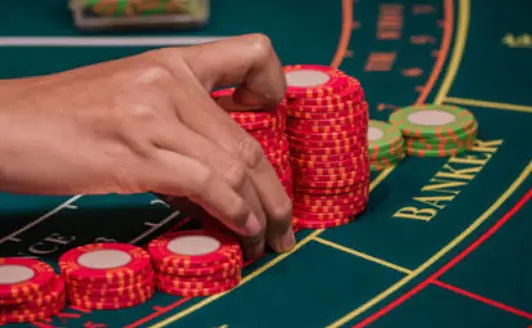
Compare it to a pass line bet with a 1.41% edge and you see the carnage instantly. Hard 4 and hard 10 at 11.11% are nearly eight times more expensive per dollar wagered. Even the "better" hard 6 and hard 8 at 9.09% are a catastrophic leak compared to virtually any other wager on the table. There is no hedging pattern, no progressive system, and no timing trick that repairs a negative expectation of that magnitude. 🎲
Where the Return Actually Comes From
Strip away the felt and the payout table is a probability distribution dressed in casino chips. Hard 4 and hard 10 each have exactly one winning combination out of thirty-six possible dice outcomes — 2.78% probability on any given roll. Hard 6 and hard 8 each have one winning combination as well, but the resolution set is larger because more easy combinations and sevens can kill the bet first. The return percentage never escapes the shadow of that single-die-pair probability.
If you insist on playing hardways, treat the wager as pure entertainment spend, not as an investment with a recoverable return. Cap it at a fraction of one percent of your session bankroll, and never press a hardway after a win. The payout ratio is a shiny lure, and the hardway bet payout return is mathematically locked at a level that guarantees long-term loss. The dice do not care about your feelings, and the 7 does not negotiate. 💀